11111

Go to Blogger edit html and find these sentences.Now replace these sentences with your own descriptions.

The so called 'Haunted' mountains of the Satpura Ranges: Pachmarhi

achmarhi the only hill station of Madhya Pradesh surrounded by waterfalls, cave temples and the forested ranges of the Satpura National Park and offers a refreshing escape from steamy central India.

Weekend respite – LANSDOWNE (from Delhi)

Go to Blogger edit html and find these sentences.Now replace these sentences with your own descriptions.

This is default featured post 4 title

Go to Blogger edit html and find these sentences.Now replace these sentences with your own descriptions.

This is default featured post 5 title

Go to Blogger edit html and find these sentences.Now replace these sentences with your own descriptions.

Sunday, May 15, 2016

The Abode Of Snow: A Journey To Goecha La

Every day you come across so many travel quotes that keep knocking your News Feed on the social networking sites, and probably, you just read them, smile, and scroll down, thinking that someday you’ll get a chance to respond to the call of the travel bug.
I, too, do this often – I mean the reading scrolling down part, but with that, I respond to the calls as well, because I believe that ‘the chance’ never comes unless you bring it in.
It was quite a few months back, when I was randomly talking to my friend, and she told me that this trek was on the cards. I have never trekked before, I had no clue how it is like to walk for hours, and neither did I clearly know the details – I just randomly agreed to the plan!
After all the anticipation, it was finally the day when I was to step out for the first trek of my life – little did I know then that it would make such an impact on me. Away from the cacophony of the urban life, being amidst nature, accompanied by the Himalayas, was indeed one of the best gifts life ever bestowed me with.
For me, the journey began from Delhi to Bagdogra, and then, an hour’s drive to Siliguri. I met all the other folks (read: friends) at NJP, from where we started for Yuksom, West Sikkim.
We were a team of 11 people, who tagged a fancy name – The Alpinists!
From NJP to Yuksom, it takes nearly 7 hours – and Yuksom is one of the most beautiful villages in the lap of the mighty mountains. There’s nothing much to explore, but still the place has a charm of its own. Before we set out for the 10 days of rigorous walk, we had a chilled out evening at Yuksom, visiting the Monastery and binged on delicious momos!
The Trek Route:
Day 1: Yuksom to Sachen – Walking through the Kanchenjunga National Park is an experience in itself. The lush greenery, the freshness in the air, the clouds playing around and kissing the peaks, the sunshine on and off – everything seemed way beyond perfect. It was raining on that day, and since it was my first time, there were difficulties – but then, when you’re there, you can easily keep the difficulties aside, and aim to move ahead.
The walk from Yuksom to Sachen was for 6 hours (considering the fact that my speed was extremely slow!).  The campsite at Sachen was in the middle of the jungles, and the eerie silence didn’t fail to give me goosebumps.
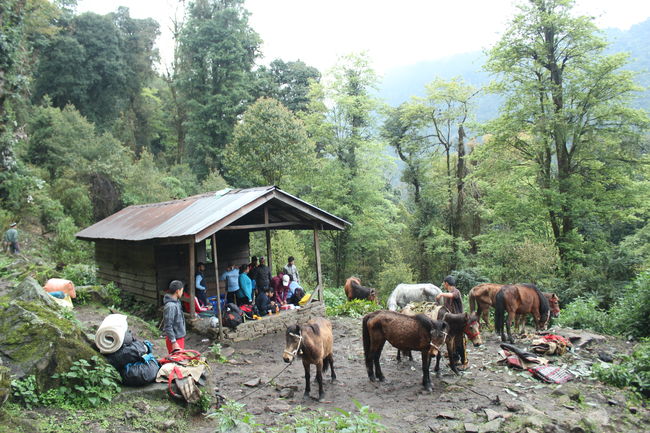
Day 2: Sachen to Tshoka, via Bakhim – The second day was way more difficult than the first day, and our guide, Aakash, had already told us about it. The trail was at a slope of nearly 70-degrees, and the temperature was dropping rapidly. It was almost 8 hours walk that day.
There were rhododendrons and magnolia blooming throughout the trail – it seemed that nature was dressed up, just to welcome us. Sometimes, I was lost in thoughts, wondering how beautiful nature can be… I felt like someone has painted the landscape, and I was walking through it.
I’ve never seen so much of colors in my life, and I felt that even the best painter might get amazed to see such variety of shades…
Tshoka has a proper campsite, with toilets, and kitchen, and a hut. There’s a monastery as well, and a little lake, adding more beauty to the place.
From the campsite, you’ll get a glimpse of Mt.Pandim and Mt.Kabru (well, yes! These are among the higher range peaks which our geography books never taught us about!).
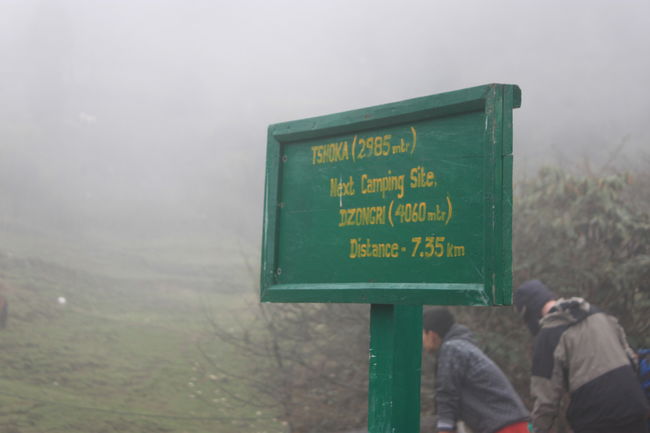
Day 3: Tshoka to Dzongri, via Phedang: The trail here was properly done with wooden logs, making the walk a bit smoother till Phedang. From there, it starts getting steep, and we experienced heavy snowfall. It’s a 7-8 hours walk, though we took more time since it’s much difficult to walk on the snow.
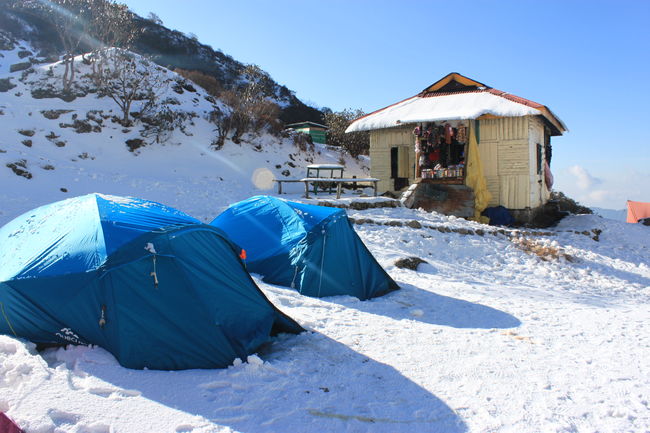
By the time we reached Dzongri, it was absolutely covered with snow. To me, it seemed like a dream - white everywhere, with little colorful tents in a row.
The night sky at Dzongri was the best that I’ve ever seen in my life… It seemed as if I can touch it, and get a star for myself!
Everyone was extremely tired and so, we all went inside the tents to rest. Only till there was the snowstorm, which blew away our tent! – Oh! What an experience it was – scary and thrilling at the same time.
Day 5: Climb to Dzongri Peak; Rest day at Dzongri – The fifth day began at around 3.30am, when we started out trek towards the Dzongri peak, to soak ourselves in the first sunshine.
The temperature had dropped much below the freezing point, still, the enthusiasm to see the Kanchenjunga kept us going.
All my mates were quite ahead of me, and slowly the distance between me and them increased, as I realized that my body was giving up. It was getting difficult for me to breathe, as my nose was frozen, and all I could do was breathe through my mouth – but my guide constantly kept telling me not to breathe through the mouth.
To be thankful to the Supreme for our life is probably that last thing that comes to our mind – we give priorities to everything in the world, and much importance to this mortal body – but often fail to realize how precious each breath is! It’s then, that I realized how a person might be feeling on the death bed, trying to gasp another breath.
I paused to breathe after every 20 steps and kept sipping the chilled water. And undoubtedly, Gurung, my guide, was the constant source of motivation.
We were still at a distance from the peak when the first rays of dawn crossed the horizon. Gurung told me about the peaks in a row – Mt. Tinchenkhan, Mt. Kabru, North Kabru, South Kabru, Mt.Pandim, and the gorgeous Kanchenjunga – I saw the peaks turning golden one after another, as the sun rays glided down the snowy steeps! What I saw is actually difficult to be put in words – one has to see it with his own eyes, to believe in the power of Nature.
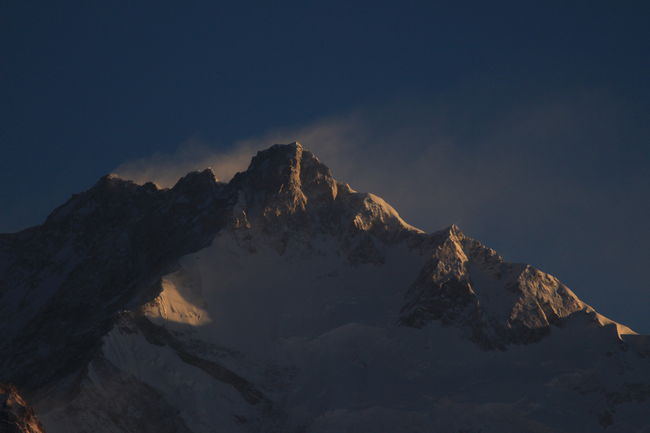
Reaching the Dzongri peak (4171 m) felt like an achievement in itself. There I stood, amazed, surrounded by the snow-clad peaks on all sides – it took me some time to believe my eyes, and somewhere deep inside, I felt proud of myself, for the very fact that I did something I never imagined I could do!
After coming back to the Dzongri campsite, we had a day to relax and enjoy the snow. The campsite looked like something straight out of the pages of some fantasy novel – with snow all around, and our yaks and horses roaming here and there. In a line, stood our colorful tents, adding vibrancy to the entire landscape.
It was a much-needed break since our muscles also craved for some relaxation. Sitting on the snow, soaking the warm sun rays and binging on Maggi and yak meat was truly delightful. Well, yes – one should definitely try the local food while on the go, and missing out this delicious yak meat cooked in typical Sikkimese style is totally undesirable!
We tried the local liquor as well, called thongba, which is made from fermented millets, and served in a bamboo mug. The most amazing thing about thongba is that it never gets over! Yes, you read it right – keep adding lukewarm water to your mug, and enjoy your drink till you feel satisfied enough!
Day 6: Dzongri to Kokhchurang - The walk was comparatively easier, as most of the trail is through a valley, and the rest of it was downhill. After much of snow at Dzongri, we got to see some green meadows, and the clouds played hide n’ seek with us, veiling and unveiling the mountains, which gave us constant company.
As we started walking downhill, I realized that it wasn’t as easy as I assumed it to be, because the snow had started melting, making the trail extremely slippery, and dangerous. The trail ran through the forest, that was a bit dense, and my friends were anticipating that a snow leopard might peek out from behind a tree – well, that didn’t really happen!
From quite a distance, I could hear the rhythm of a flowing river, but couldn’t see any. It was only when we stepped out of the forest, and reached the Kokhchurang campsite, that I got to see Prekchu closely for the first time.
Kokhchurang campsite was exactly like those European country sides that I’ve read about in books and imagined all my life – a little cottage next to a forest, with a river on one side and a wooden bridge, a patch of grassland where yaks and horses grazed, and the mountains at a distance, standing like a boundary wall to this little picture-perfect settlement.
The evening at Kokhchurang was one the best times I’ve had in the entire trek – sitting by Prekchu, listening to its constant rhythm, observing the flow and the distant mountains, with my feet dipped in the freezing cold water – one of those moments which made me feel how I miss all these in the otherwise monotonous life.
Day 7: Kokhchurang to Lamuney via Thangsing – This was comparatively an easier walk, mostly through the jungle trails, and valley – and there're not much of hurdles. The best part of this trail is that you’ll be accompanied by Prekchu River throughout, and can gaze at Mt.Pandim and Mt.Tinchenkhan (if the clouds don’t cover them up)!
The narrow streams that were flowing into Prekchu crisscrossed our way every now and then, and although they had wooden bridges, I chose to cross the streams without using the bridges – it’s a bit of a risk, but totally worth taking (just make sure you don’t wet your shoes much!).
The forest trail had rocks covered with soft moss, and icicles hanging from them – these were the corners where the sun rays failed to reach. As the forest trail ends, and you are about to reach Thangsing, there’s a patch of grassland – a somewhat mystical place – which had the fragrance of wet grass soaked in the dew drops, infused with the smell of wet earth absorbing the mild sun rays – and as I sat there with my friend, it felt like time has stopped.
A few minutes’ rest, and we started walking again – we met a few others who were coming back that day, after doing Goechala – and they were all telling us about how their experience was.
We reached Lamuney by the afternoon – which was our last camp site. The tents were put right next to the river, and we could clearly see the mountains on the other side.
The day ended by 7 in the evening, and everyone had an extreme adrenaline rush, as our guide instructed us that we have to start our journey for Goechala at 2am!
Day 8: Lamuney to Goechala, and back to Thangsing - The temperature was well below freezing point when started for our ultimate destination – it was dark, with the stars shining brightly on us. Because of the chilly wind, it was quite difficult to breathe – however, the excitement kept us going. In the darkness, we crossed the Samiti Lake, and by the time I reached the Goechala viewpoint one, it was 6.30am. A topsy-turvy path led to the point, from where I saw Kanchenjunga, standing right there in front of me – pristine, glittery and more gorgeous than one can ever imagine!
The 7days’ hardships felt worthy after that one glimpse – and I felt the satisfaction and happiness of my being. My guide was so happy that I did it, for he was a constant source of courage when I almost gave up on the way.
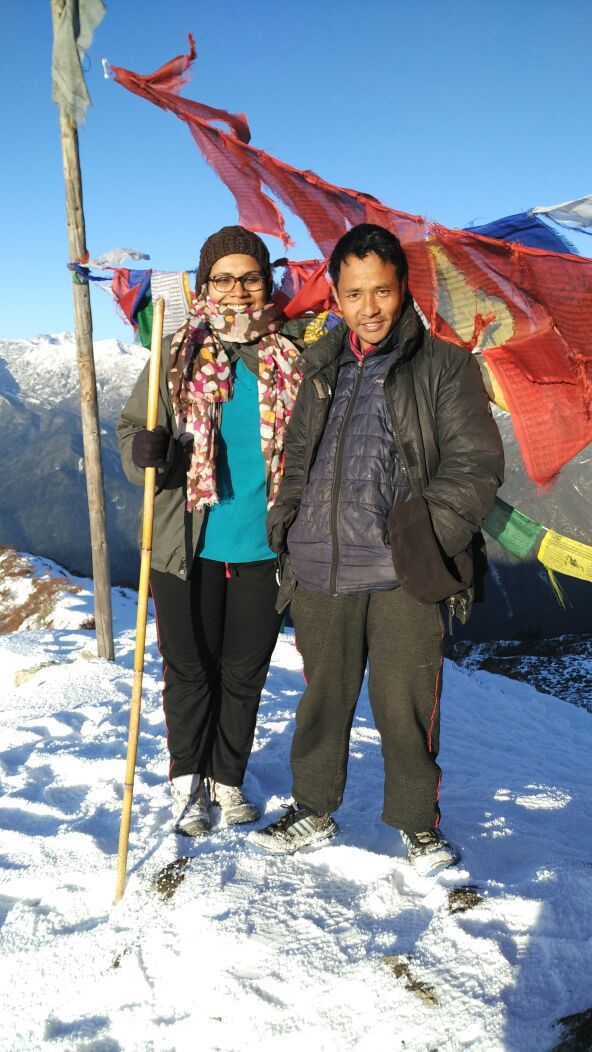
We stayed there for around 15-20 mins, and started our walk back towards the camp.
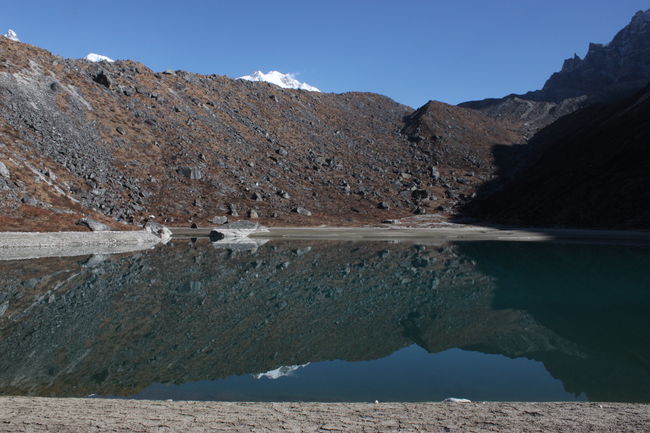
To pause by the Samiti Lake was a must – and I wondered why I never knew about this place earlier. We hear so much about Pangong in Ladakh, may be because Bollywood has popularized the place, but Samiti Lake was no less than that. The crystal clear blue water, with a thin sheet of ice, reflected the mountains that surrounded it. Me and my guide sat there and had our breakfast, enjoying the eerie silence, which was broken at times by the call of the Himalayan Monals.
We reached the Lamuney camp site at around 9.30 am, and a few of my friends were already back. I was wondering that those who were making it to the second viewpoint would be witnessing a more picturesque view.
Everyone returned at around 1pm, and they narrated how dangerous and beautiful it was beyond the first viewpoint. I was glad that they could make it, for not many can reach up to that level. 
After lunch, we set out for Thangsing, where we were halting for that night. We managed to get a room in the trekker's hut there.
Day 9: Thangsing to Tshoka, via Kokhchurang and Phedang - Returning has always a string of sorrow attached to it, and it seemed that even Nature was bidding a sad goodbye. As I walked back, the same trails looked a bit different - the grassland where I sat, had lost its fragrance - the icicles had melted - sun rays successfully seeped in, soaking the dewdrops and making the moss lose its lustre. 
Even Prekchu sounded different - I felt that the sound of the flowing river when I climbed uphill, was more joyful than the one i listened to while coming downhill -  I wondered if Prekchu would miss me the way I would do.
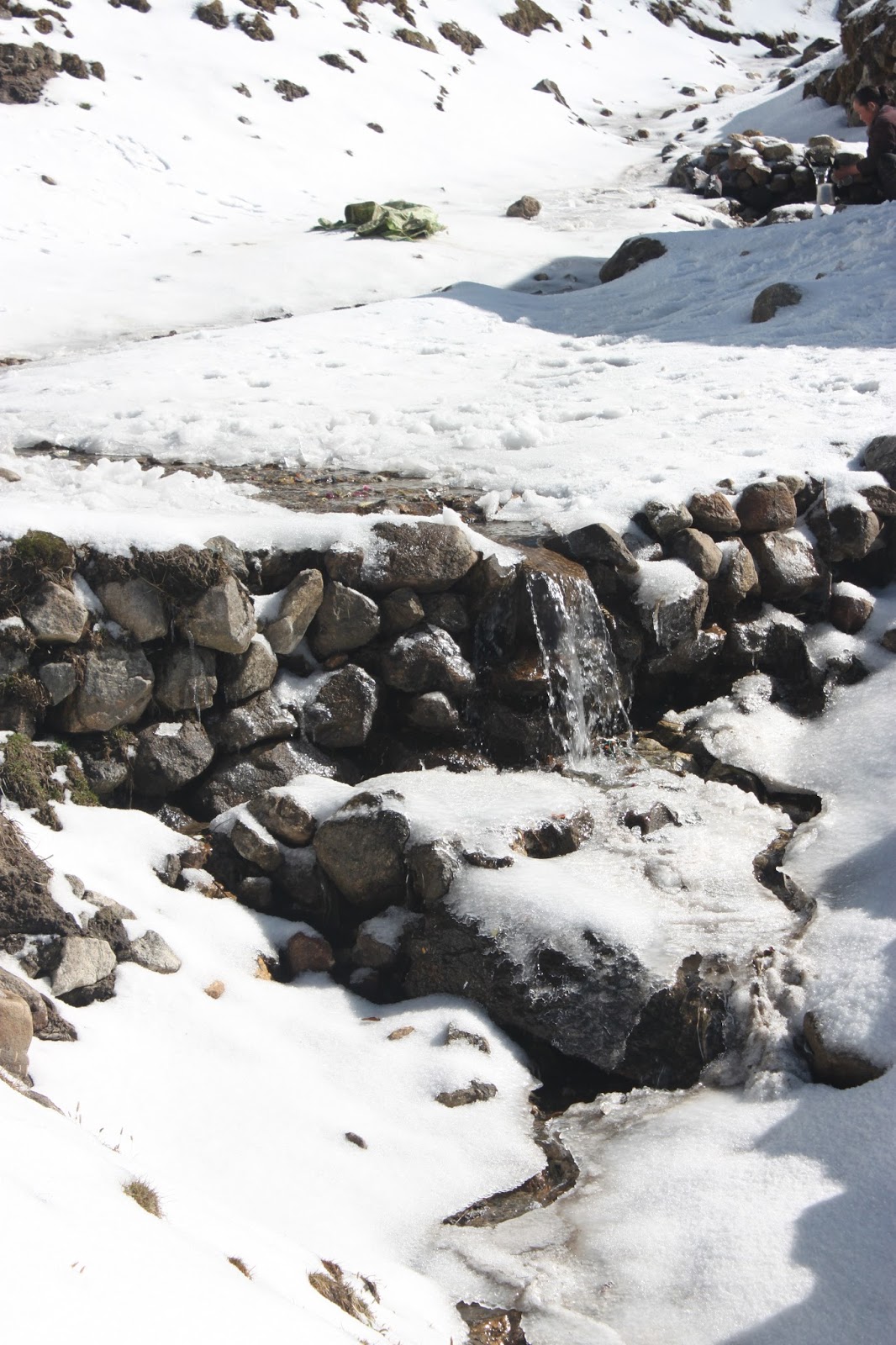
The walk from Kokhchurang to Phedang is entirely through the forest, where you'll come across several waterfalls, and we filled our bottles and drank the sweet fresh Himalayan water - bliss! I walked slower than I usually did, for I wanted to spend more time there, somehow the thought of coming back to the city haunted me - I wished I could stay there longer.
By the time we reached Tshoka, it was evening, and we had quite a long day. The guides gave us a farewell treat that day - with yak meat, and chicken, and cake! Such a bunch of adorable people they were.
Day 10: Tshoka to Yuksom, via Sachen - There was a mixed emotion - the paradox of life - the joy of returning home, and the sorrow of leaving Nature behind.
I walked alone that day, as everyone else were way ahead of me - I, as usual, took more time, to absorb all that I could, and made lame excuses to delay. My guide was curious to know whether I would ever come back for another trek there or not, and was eager to know how my otherwise usual life would be, once I head back home. I was replying to him, quite unconsciously, as I wanted to avoid those thoughts!
After reaching Yuksom, the first thing that I did was taking a bath - it was after 9 days that I got to take a bath!
And we decided to celebrate our achievement, that evening! Good food and alcohol was all that we needed, after the 10 days of Maggi and boiled eggs!
The next morning, I took a cab from Yuksom to Siliguri, and then To Bagdogra, as I had my flight to catch. All my friends stayed back, since they had their train in the evening.
The journey added a lot to my life - it's one of the most amazing chapters that I would never get bored of revisiting. It made me realize that life is what happens to you when you least expect it. I met some amazing people, who added some vibrant colors to my story. And i saw Nature - at its best!
To everyone out there, reading this - break the shackles of your monotonous life, have the courage to set out of the comfort zone. For once, breathe - and feel the importance of your breath. I can bet that you won't regret.
Happy traveling! 
Photo Courtesy: Rijuman Datta, Kausik Pal.
The Trek Album:


Saturday, May 14, 2016

Destination Cafes- COFFEE CULTURE THE RISTORANTE LUCKNOW

By Shubhashish Chaudhri


Pic source Zomato

Coffee Culture The Ristorante is a new small cafe-cum-restaurant which has opened up just recently in Lucknow and I should say that it’s a must visit place for all.

It is situated right in the main market of mahanagar. It is on the first floor of a complex which is right in front of my school which is Montfort Inter College(formerly known as MBIC).

It is a pretty nice cafe with a decent ambiance, good food and above all decent cost and even though i am not much of fan of Italian food yet I haven’t come across a place like this for
for Italian food.
A very dear friend of mine loves their pasta and irish a lot and she asked me to try it and once again, not being a fan of irish coffee i had my doubts but trust me not just these two items but everything is worth it.


Their coffees are also of another taste and level and i just love their pizzas,coffees and pastas.

They have got couches and solo chairs. It even has an option for outdoor seating but if you visit this place during noon you might face a little bit sun.

The Service is very prompt and attentive.

It is very economical and trust me they even have combos that suite a group treat.

I suggest you must go to it once when you are in lucknow. “Gaur farmaiyega, lucknow mei honge aap.”


About Shubhashish Chaudhri

An avid food lover, loves reading like anything and a big MOVIE and English tv shows FREAK and going to new places even though i haven’t been to a lot of places but I intend on travelling through the entire country during my life. 

Saturday, April 9, 2016

Destination Cafes- WAKE & BAKE CAFE SHIMLA


Pic source: Wake & Bake Facebook page


Wake & Bake is one of best cafe on hills I have visited so far.

Situated right at the heart of of city. Wake & Bake is on the 2nd floor of a building in front of the Shimla Town Hall on the Mall Road.  


 Beautiful ambience,  bright yellow walls, comfortable wooden benches for sitting, and windows overlooking the Mall Road. it’s a colorful chirpy cafe decorated with amazing art works on the walls. They also have an open air terrace sitting from where you can get a view of the beautiful valley on the other side. 


It serves Italian, French, Lebanese, Mediterranean and Continental delicacies. 

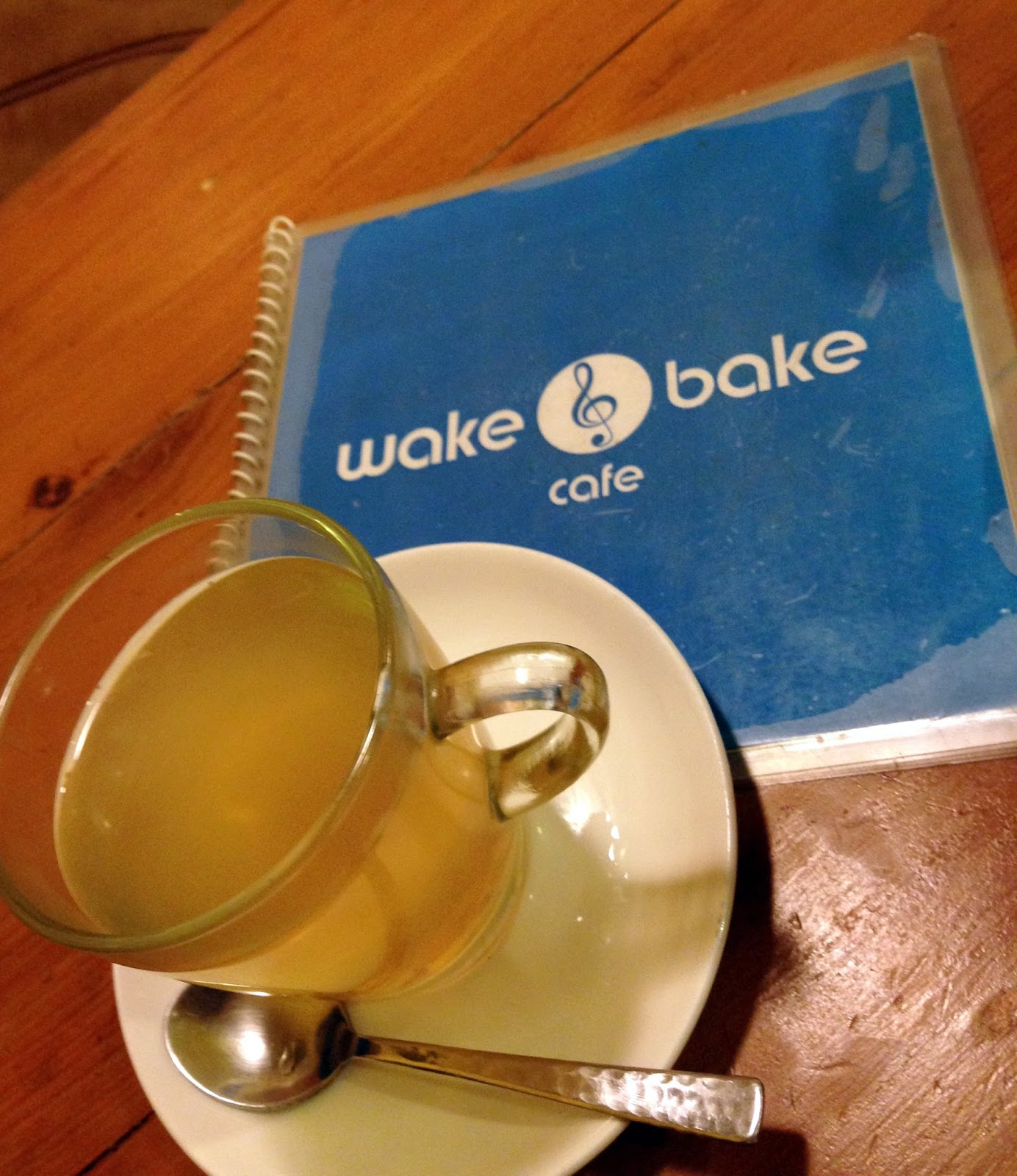
Some of the best pancakes I’ve ever had, great hummus and pita platter and Kashmiri kahwa at a very reasonable price. 

Not only great tasty food but also great service.

Don't forget to visit this place when you are in Shimla. 

If you are lucky, you might witness to a jamming or book reading session at Wake & Bake.

It's great place to hang out and sip your favorite cup of  tea or coffee.


.

Thursday, March 24, 2016

A Day's Trip To Agra

With Love, From Agra


For someone living in Delhi, there are ample options to choose from, when it comes to pick a destination for weekend escape.
I prefer the hills and the serenity more, but a friend who came to visit was more keen on exploring Agra. I’ve been to Agra before, with parents and cousins, and this was my third visit to the city. Surprisingly, it was as good as the first time, and richness of the city didn’t fail to amaze me, all over again.
How To Reach: If you have a car, then you can drive down the Yamuna Expressway, and it’ll take around 3 to 4 hours, depending on the traffic, and the halts.
We rather chose the best option – the 6 am Shatabdi, from NDLS. It takes 2 hours in the train and you’ll reach Agra by 8am.
Brush up your bargaining skills, because the autowallahs have already the planned to rob you! The distance from the Agra Cantt to Taj Mahal is around 6Kms, and its for 50 bucks, so don’t pay more!
We were in the mood to splurge, so we decided to have breakfast at The Taj, which was a grand spread, and we hogged to our hearts content.
Then we headed towards Taj Mahal – the epitome of Love!
Try reaching there as early as possible, because the more late you get, the more crowded it’ll be. Do take a guide, YES! That’s a must, because otherwise you’ll miss all the fun stories – these guides have a different way to narrate the Mughal tales! (Bargain with the guide, it’s just Rs 200 that we paid for a 3hours tour!)
We’ve all read about the Mughal grandeur and architecture, and much more about Taj Mahal, but unless you see it, you’ll not realise how thoughtfully it was done – like there’s so much of science behind its construction – starting from earthquake resistance to 3D effects!
From Taj Mahal, we headed towards the Agra Fort, which took another  2 hours to explore. Most of it has been closed for the tourists now, and the pollution would not let you have a clear view of the Taj Mahal from the Fort.
For lunch, we went to a café called Sheroes, which is run by the acid-attack victims – and I would suggest everyone to pay a visit there, not just for the food, but for the ambience. It’s a ‘Pay as you Wish’ café serving quality food. You can also join them for cooking, and of course have a chat with them, they too have wonderful stories to tell you.
If you are keen on shopping then you can explore the local market, but they have exorbitant prices, for they mostly aim to sell those to foreigners.
If you plan to stay for a night, then definitely take a cab and head towards Fatehpur Sikri. Because we had to return back that day itself, we took a bus at 4pm, and we reached Delhi by 7.30 pm.

Yes, Agra can be well explored in a day, and it won’t pinch your pocket too!

Sunday, March 13, 2016

'Ayodhya' the ancient city from Ramayan

By Shubhashish Chaudhri


AYODHYA- the land of temples and peace
Well being in the final year of college has brought about a lot many changes and various plans have been made but to execute those plans is another thing. A sudden plan made alongwith friends meant that finally i am going to get a chance to go out to places which are there on my so-called BUCKET LIST. On a chilling cold morning of January to get up at 5:30 am in the morning is in itself a big mission impossible but we are all like that only. For classes which happen at 10am we cant get up but just tell us that we are travelling somewhere i will get up in the middle of the night.


How to reach-
Ayodhya is not a very big place so it can be done only within 12 hours max including travelling(and yes i am not lying). You can either go by bus which takes some 2 and half hours. Ayodhya is just a 130 odd kms from lucknow. Oops i forgot this is not just meant for people from lucknow. Anyways since we were some 6 friends we booked a cab and off we went.
Ayodhya is on the right bank of the river Sarayu, 8;km from Faizabad. This town is closely associated with Rama, seventh incarnation of Vishnu. According to the Ramayana, the city is 9,000 years old and was founded by Manu, the first man in the Vedas, and law-giver of the Hindus.
Since it is mainly the place where you have temples(12) in number to be precise, there is only so much that you can do but still. It would be better if you have someone with you who has either been to ayodhya or knows about the place and temples. A guide wont b of much help. We had one such person with us.


Kanak mandir
Kanak Bhawanin Ayodhya is the palace of Sri Sita and Rama. It was a welcome gift to Sita from her mother-in-law Kaikeyi. Kanak Bhawan still exists in Ayodhya.


Hanuman Garhi, a massive four-sided fort with circular bastions at each corner and a temple of Hanuman inside, is the most popular shrine in Ayodhya. Situated in the center of town, it is approachable by a flight of 76 steps. Its legend is that Hanuman lived here in a cave and guarded the Janambhoomi, or Ramkot. The main temple contains the statue of Maa Anjani with Bal Hanuman seated on her lap. The faithful believe wishes are granted with a visit to the shrine


Ram Janmabhoomi (literally, "Rama's birthplace") is the name given to the site that many Hindus believe to be the birthplace of Rama, the 7th avatar of the Hindu deity Vishnu.
The Ramayana states that the location of Rama's birthplace is on the banks of the Sarayu river in the city of Ayodhya. A section of Hindus claim that the exact site of Rama's birthplace is where the Babri Masjid once stood in the present-day Ayodhya, Uttar Pradesh.


Janaki Mahal established by Late Sri Mohan Lalji, run by Trust, beautiful Mandir of Janki Mata & Lord Ram. Many social activities, food for poor people, charitable medical facility for poor people managed by Sri Vishwanath Murarka.


Sarayu
Ayodhya, capital of King Rama is mentioned on the banks of Sarayu river. Sarayu river is mentioned in great details in Ramayana. Ayodhya still exists on the banks of river Sarayu in Indian state of Uttar Pradesh. It is a tributary of the Ganges which meets two other rivers at the confluence (sangam) in Uttar Pradesh.

All in all, it will still be a nice experience one which everyone should have once in their life and lastly not to forget the place is famous for its besan laddoos and pedas.


About Shubhashish Chaudhri

An avid food lover, loves reading like anything and a big MOVIE and English tv shows FREAK and going to new places even though i haven’t been to a lot of places but I intend on travelling through the entire country during my life. 

Saturday, March 5, 2016

The 'Golden City of Rajasthan' - Jaisalmer (Part 3)

By Parth Yadav

...continued from Part 2

But first things first, one thing was left in Jaisalmer before we could ‘hit the road’ and that was the very famous JAIN TEMPLES. Not for religion, not for praying for marks or asking for a girlfriend, but just for travel’s sake do pay a visit to these Temples! It will be worth it. Within the Jaisalmer Fort walls is a maze-like, interconnecting treasure trove of seven beautiful yellow sandstone Jain temples, dating from the 15th and 16th centuries. These temples are built in the Dilwara style that is famous all over the world for its architecture. The style got its name from the famous 'Dilwara Temples' situated on Mount Abu, a famous Hill station in Rajasthan. The Jain temples are dedicated to Rikhabdevji and Shambhavdev Ji, the famous Jain hermits known as ‘Tirthankars’. Like other structures in Jaisalmer, these temples are craved of yellow sandstones. The beautifully carved decorations on the wall will give you divine peace. One couldn’t ask for a better start to the day! Authors Advice: Opening and closing timings of these Temples have a habit of changing, so do check with the caretakers. Shoes and all leather items must be removed before entering the temples.


Post this we had our breakfast at one of the numerous restaurants within the Jaisalmer Fort Complex. And then went straight to one of the ‘Rent A Bike’ Shops! Yes!! It was finally time for some adventure. Authors Advice: There are plenty of ‘Rent A Bike’ shops in Jaisalmer, which provides you Activas, Bajaj Discovers, Avengers and Royal Enfield on rent. The rent varies from vehicle to vehicle. And all they need for security is a minimum token amount and yes, a valid photo Identity Card. All this is returned once you handover the keys of the bike back to the owner. The petrol is on you! And hence, it is highly advisable to get your tank full before you start. There are ‘NO’ petrol pumps on the way. Only some ‘Kirana Shops’ which sell petrol at almost twice the actual rate! Also, booze in the Desert is again, pretty expensive, so it’s advisable to buy from Jaisalmer itself, before you leave.

So, yes! Handing over my voter ID card to the shop owner and taking the keys of an Avenger, we kickstarted our way to the real desert! Basically, one should reach Sam around sunset i.e. around 4:00- 5:00 PM. So, even if you start from Jaisalmer by 2:30-3:00 PM, it would suffice. But we had other plans! We wanted to cover the nearby areas as well before reaching Sam, specifically ‘Kuldhara’. What is Kuldhara? Wait! Patience yields the sweetest fruits! :P

Hence, we started off from Jaisalmer at around 11:30-12:00 PM. Our first halt was the BADA BAGH or the ROYAL CENOTAPHS. Bada Bagh is a garden complex about 6 kms north of Jaisalmer on way to Ramgarh, and halfway between Jaisalmer and Lodhruva. Authors Advice: Although the authorities have placed adequate milestones/ boards at a number of places and in fact at every turn keeping in mind all the tourist hotspots en-route to Sam yet, do carry a small map of Jaisalmer or activate the GPS on your phone before hitting the road. The Bada Bagh has basically three different things to watch, a garden, a tank and a dam. Other interesting monuments in the vicinity are the Cenotaphs. These cenotaphs also known as ‘Chattris’ and were constructed by the various Bhatti rulers. One cenotaph has been erected for each ruler. The oldest among them is the cenotaphs of Maharawal Jait Singh who reigned from 1470-1506. This tradition was discontinued when in 1947, one of the prince died of a mysterious disease! The place is basically isolated yet the garden offers a stunning view. If you visit the place during sunrise and sun set, you are guaranteed of beautiful moments, which you cannot avoid clicking.


Moving on, was the destination I was most eagerly waiting for! The KULDHARA VILLAGE!! So, basically, I am one person who, from a very early age has been hell interested in ‘apparently’ supernatural stuff. The word ‘haunted’, where on one hand gives people goosebumps, on the other, in my case, it gives me an adrenaline rush to go and the check the place out. And that’s what we exactly did. Kuldhara is almost 18 kms from Jaisalmer. While going towards Sam, you have to take a right turn from the main road and a few kilometers on that right turn, you’ll find the entrance to Kuldhara. Once you pass through the entrance gate, you automatically get a very eerie feeling. A perfect place to be inhabited lies all vacant. No sign of any human anywhere! A small patchy road leads you inside the village. And suddenly, you find yourself standing right in centre of the village in front of a temple! Yes, a temple! With a lit ‘diya’ kept inside the temple! If this wasn’t enough, out of nowhere an old man came from behind and said ‘Khamma Ghani’ or “Hello’! We actually and literally froze for a couple of seconds. Until one of us regained our senses, and replied with a ‘Ghani Khamma’. That’s how you revert to a ‘Hello’ in Rajasthan. Our guide in Jaisalmer taught us this. Anyways, it turns out, he was indeed a human, a live human, with blood and flesh and was the caretaker of the temple. He welcomed us and then on being asked told us the story behind Kuldhara, a happy and prosperous village turning into a deserted and supposedly haunted hamlet! So, it turns out that once there was a Prime Minister of a kingdom who was not just powerful but an evil man as well. He forced all the villagers to coerce the village head to allow him to marry the village head’s daughter. Though, the villagers were against it and tried to protect the Lady, yet all their attempts went in vain in front of the powerful minister. Hence, they decided to leave the village under the cover of the night, thus safeguarding not only the village head’s daughter but for that matter even their own daughters from the evil eyes of the Minister. But the story doesn’t end here! Before leaving the village, the villagers cursed their own village and said that no man shall ever be able to inhabit this place ever again. And so it happened! As mentioned before, a perfectly prosperous village with perfectly good houses now lies barren and crumpling with time. Apparently, some people who didn’t believe in this story and tried to stay in the village were chased away by some or the other paranormal activity. Frankly speaking, there is something in the air of Kuldhara, which somehow forces you to believe this story.


Anyways, it was almost 3:30 PM and we were yet another 25-30 kms away from Sam, we bid farewell to the old man, and were back on the road. Another, 45 minutes on the main road and we reached our final destination… the mighty SAM SAND DUNES!! In short and I couldn’t be more precise in saying this, we were basically in the centre of the “Great Indian Thar Desert”! These dunes are 42-45 kms away from Jaisalmer and a nice sealed road maintained by Indian Armed Forces leads you to the place. Authors Advice: Driving a bike on this road is in itself a roller coaster ride. There are periodical crests and troughs which makes it almost impossible to see what’s coming from the opposite side of the road. So beware! And if this wasn’t enough, like in UP or Delhi you find dogs and cows loitering on the road, in Rajasthan, you get to find camels!


Anyhow, there is no point coming to the Thar Desert if you don't go for the Desert Safari. That is why Sam Sand Dunes are becoming the major attraction in Jaisalmer. This is the closest place from where you can lose yourself in the Great Thar Desert.  A rare desert area which lies just on the edge of Jaisalmer Desert National Park and is also rated as top 10 must see tourist destinations in Rajasthan by Lonely Planet & Tripadvisor, Sam Sand Dunes are simply amazing.

About Parth:
Currently pursuing his bachelors from National Law University, Lucknow is a bibliophile and an avid fiction lover. Travelling is not just his hobby but his passion. He likes to explore the unexplored and does things which aren't mainstream. Mountains, "supposedly" haunted destinations and bike trips are what attracts him the most. A certified trekker by the Youth Hostel Association of India, he dreams to cover the Himalayas on his bike someday!


Twitter Delicious Facebook Digg Stumbleupon Favorites More